By Nicole Hallengrogg
7-27-2008
Last weekend I joined with thousands of bikers to ride through Montana and Wyoming's Beartooth Pass Highway. Now if you would have asked me a year ago if I saw myself riding switchback after switchback in leather boots and jacket on the back of a Harley, I would have taken a moment to contemplate, laughed and said "anything is possible, I guess". Now what amazes me the most about this whole experience is why I hadn't done it before.
There's nothing like it.
There's nothing like the wind in my hair, the cool breeze and hot patches of sun warmed road, the balmy segments of valley that feel like hot, moist, summer days back East. The endless snaking road stretched out before me like some great slumbering serpent. The great hillsides giving birth to segmented crimson and golden rock formations shaded into jagged sculptures of earth by sun. The treelines opening like unearthly gates to mountains that jet up to the sky, pointing sharply at the heavens, the snowcapped peaks, river valleys, and high alpine lakes that mirror wildflowers and sky.
There is nothing like the meditative hummm; a loud silence giving room for only breath and sight. It is here that I have let Zen come over me. Holding on to forward, leaving backwards in my past. It is here that I look out upon our world and see the sunset behind white and lavender mountains.
They say that that close to ten thousand bikers showed up for the Red Lodge Rally. Like some huge gathering of leathered monks, we shared these views together and alone; a rumbling sacred silence, a meditation on freedom and beauty.
And yet most people imagine a gathering of this sort to be littered with loud parties, street fights, broken bottles and women dressed in red paten leather platforms and black leather skirts- and no doubt, there was some of that. But there is something more. That gathering, that 180 miles of mountain road, those bikes riding simultaneously staggered along a winding stretch of the most beautiful highway I have ever witnessed is something pretty incredible. There is something about the ride and the rider that lends itself to our desire for freedom and beauty and how we must take it wherever it is or ride to meet it if we must. How every man and women wants to let go of the stuff behind them and move only forward, and look out onto this world with love and appreciation for its magnificence. Our tribute to its beauty is to appreciate it, however we can, and if it takes ten thousand humming motorcycle monks to do it, then so be it.
Motorcycle Zen


What I Learned from Jefferson's Mountain

7-26-2008
A few weeks ago President Bush welcomed 72 new Americans as they took their oath of citizenship at Thomas Jefferson's famous estate, Monticello, near Charlottesville, Virginia. 72 new citizens got a healthy taste of free speech as Bush was continually heckled from the crowd.
I happened to be in Virginia too, visiting relatives, and as I watched Bush give his speech on TV, I wondered what it must feel like to become a citizen on such hallowed ground. I had an urge to visit Monticello and so a few days later there I was- standing atop Jefferson's mountain, guidebook in hand.
Many considered Jefferson a man of great genius. Born into one of the nation's wealthiest families he began as a lawyer them moved into politics serving as Governor, Secretary of State, Vice-President and President. Interestingly enough he did not enjoy public service saying, "I have no ambition to govern men; it is a painful and thankless office."
He had a few hobbies to distract him from his dreaded day job. He was a respected horticulturist, architect, archaeologist, paleontologist, inventor, collector, and author.
He was a radical. He spoke out against religious tyranny, persuasively argued for the separation of church and state and access to public education. He also opposed slavery, notably in the Declaration of Independence, however that section was removed by Congress before the document was approved on July 4, 1776. He once said, "I have no fear that the result of our experiment will be that men may be trusted to govern themselves without a master."
Yet Jefferson inherited 200 slaves and "owned" approximately 200 slaves at all times throughout his life. It's believed that he fathered several children with a slave named Sally Hemmings, herself the daughter of an enslaved black mother and white slaveholder.
This was on my mind when I arrived at Monticello; when I saw the one room dwellings that an entire slave family would have shared situated next to the pillared perfection of Jefferson's mansion, and when I learned that Jefferson freed only seven slaves during his life, most of them Sally's (and his) children. As I glimpsed the life of an iconic man, the words of another American icon, Langston Hughes, came to mind:
Let America be the dream the dreamers dreamed--
Let it be that great strong land of love
Where never kings connive nor tyrants scheme
That any man be crushed by one above.
(It never was America to me.)*
I believe that Jefferson would have had a deep understanding of these words. He was an oppressor who was keenly aware of the dehumanizing affects of his oppression.
In the 1780s Jefferson brought Sally's brother, James, to France with him to learn the culinary arts, and James returned to Monticello to train other slaves to be gourmet chefs. Guests at Monticello were served macaroni, waffles, and ice cream, considered novelties at the time. Some of his favored slaves became skilled craftsmen, creating equipment, furniture, and mechanical devices out of raw materials according to Jefferson's specifications, many of which contributed to modern inventions.
He imported squash and broccoli from Italy, beans from the Lewis and Clark expedition, French figs, and Mexican peppers, planting them in his abundant fields, groves and gardens, all of which were tended to by slave hands. Many of the items grown on his land weren't seen anywhere else in the country and today are staples of American diets. Who should we thank for these influences? The man who fancied foreign commodities or those who ploughed, planted, and nurtured the land to produce those commodities and lay them at his table?
"I would rather be exposed to the inconveniences attending too much liberty than to those attending too small a degree of it." Jefferson wrote, and yet he could not forgo his conveniences in order to grant liberty to those who spent their lives in his service. He spoke of releasing his slaves once he had paid his debts, but that day never came. Jefferson continued to collect, import, and spend until his death, and his slaves, some of whom would have been his grandchildren, were auctioned off on Monticello's sweeping lawn.
He wrote of his hypocrisy, "We have the wolf by the ears; and we can neither hold him, nor safely let him go. Justice is in one scale, and self-preservation in the other."
Thomas Jefferson likely was condemned by no one but himself. What is it that we, today, do not condemn each other for? What injustices committed for today's conveniences will bring tomorrow's scorn?
I believe those who stand on emblematic mountains each day and take oaths to this country will help us as we struggle with these questions. In the meantime, I'm going to continue reading words that inspire me to go rightly into the future while never forgetting the past.
O, let America be America again--
The land that never has been yet--
And yet must be--the land where every man is free.
The land that's mine--the poor man's, Indian's, Negro's, ME--
Who made America,
Whose sweat and blood, whose faith and pain,
Whose hand at the foundry, whose plow in the rain,
Must bring back our mighty dream again.
Sure, call me any ugly name you choose--
The steel of freedom does not stain.
From those who live like leeches on the people's lives,
We must take back our land again,
America!
O, yes,
I say it plain,
America never was America to me,
And yet I swear this oath--
America will be!*
*Selected excerpts taken from Langston Hughes' poem Let America Be America Again.
Dominating the world one Gold medal at a time

By Joel Ebert
7-25-2008
The obsession that some people have over the Olympics confuses me. I am not anti-American, but sometimes I wonder if people are rooting for the American team for the right reasons.
Allow me to digress.
Occasionally I run into people that I enjoy talking sports with. Seeing as how I live in Chicago, I mostly run into people that want to talk about whatever sport is in season. There are so many Cubs fans right now that you wouldn’t even believe it.
On occasion though, I run into Chicago Bulls fans. We reminisce about the 90s and Michael Jordan and Scottie Pippen (sometimes Dennis Rodman) and their dominance over the NBA for six years. The thing that strikes me odd about this is not that people stopped liking the Bulls when Michael Jordan left, but that people seemed to stop liking them when their dominance was over, although this coincided with Jordan’s exit.
I don’t exclude myself from this observation. I especially lost interest once Jordan and Co. dismantled; leaving a team of mediocrity that was in place for the same amount of time as the one that was dominant - six years. The seasons between 1998/99 and 2003/04 were among the worst seasons (record wise) the Bulls have played in their entire franchise.
And then suddenly the 2004-2005 season catapulted them back into the playoffs and coincidentally, popularity. For the past three seasons now there has been a level of excitement surrounding the Bulls that have not been seen since the Jordan era. Once again, I am not immune to this. At some point in the 2007 season I found myself at a local bar watching one or two playoff games that the Bulls were in. This is especially odd because I probably didn’t watch more than five minutes worth of basketball since that wonderful 1997/98 season when the Bulls won their sixth title.
This all occurred to me as I began doing some research on the 2008 US Olympic Basketball team. With a team featuring a host of NBA superstars including LeBron James, Kobe Bryant, and Dwayne Wade, there has been much excitement surrounding it. Some people have even called this the Redeem Team (an obvious take on the 1992 Dream Team which featured M.J., Larry Byrd, Charles Barkley and Magic Johnson) because of the failings of the US Olympic basketball team in three previous Olympic competitions. And by failings I mean their inability to win the Gold medal.
So now all of the sudden, perhaps because of the Olympic team, we may see a surge in basketball fans. But I am pretty sure that this will only happen if they win the Gold. If they fall anywhere short, it will be seen as a disappointment.
Now I’m wondering if this is such a good idea – to break things down into such extremities. Why is it that we feel disappointed when our team does not succeed in the fullest capacity possible?
I will come back to this question later.
It seems to me that there are two types of sports fans:
1) The type of fan that enjoys the actual sport and who may or may not like a particular team for one reason. Reason may include physical location or personal upbringing.
2) The type of fan that claims to enjoy a particular team but whom only passively enjoys the actual sport.
The major difference between these types of fans is where their allegiance lies – in the team or in the sport. You can determine whether you or someone you know fall into which category by asking yourself a simple question: If the I watch most often was the worst team in the league/division/conference/etc for several years, would I continue to watch/follow/like them?
You should be able to figure out what type of fan you are by answering this question.
Now let us go back to the question I asked above. Why is it that we feel disappointed when our team does not succeed in the fullest capacity possible?
Perhaps one of the reasons (and most likely not the definitive reason) is because when the team that you support fails, you in essence fail along with them. And when the team succeeds, we succeed with them. This is exactly why I think so many people are excited about the 2008 Olympic basketball team and to a larger extent why so many Americans enjoy watching the Olympics.
We inherently desire our team to succeed because it ultimately reflects on our nation. Winning a gold medal says not only that we have dominated in one sport over the rest of the world; it also gives us that feeling of dominance over the rest of the world that we felt for so many years.
Looking at the sluggish economy, the weakening US dollar, highly disputed foreign policies, and a much despised President, the United States is viewed today as less dominant in the world than it used to be. So we look for successes and dominance in any form we can get them. This may secretly be the reason why so many Americans will glue their heads and hearts to the US Olympic team this summer. Not because they love the sport that they are watching, but because they are yearning for American dominance in one form or another.
And honestly, I can’t say I blame anyone that may feel this way. I’m not saying we need to dominate the world, but it would be nice to be a leader in the world again, and perhaps an Olympic Gold medal will push us in the right direction.
Black Superheroes Wanted

7-24-2008
How do you make a movie that relies entirely on America’s sordid racial history, without ever talking about race? Ask the makers of Hancock, they seem to have it down pat.
John Hancock [Will Smith] is a superhero that protects Los Angeles, begrudgingly. Drunk, foul mouthed, bedraggled, sexist, homophobic and ethnically insensitive, he’s about as far from a Superman as you’re ever going to get. But we find out that all Hancock needs is a little TLC.
A blow to the head 80 years ago erased his memory, so he lives in isolation from society, saving it without being of it. But all that changes when he meets Ray Embrey [Jason Bateman], a public relations man down on his luck who decides to help Hancock clean up his image. Oh, and we find out that Bateman’s domestic dream of a wife Mary [Charlize Theron] is really a superhero too, and did I mention that she was married to Will Smith for 3,000 years?
Let the games begin.
This is a movie about a black superhero that has nothing to do with a black superhero. Though Will Smith is obviously black, the film studiously avoids any exploration of what that means. Hancock has no cultural context. Throughout the film, he has no connection to a community, to a family, to a culture, to an identity, to anyone who looks like him. He is completely alone. A metaphor for the state of Black America? Try it on.
That is not to say that there aren’t other people of color, and even other black folks in the film. They’re all over. They’re the Indian store clerk, the Asian gangsters with automatic weapons, the black and Latino men who populate the jail Hancock goes to (oh yes, they send him to the slammer) – in fact, there is not a single black man in the film, other than Hancock, who is not shown as a dangerous criminal (and he’s kinda iffy). With that kind of PR, we can see why Hancock ain’t trying to claim his people too quick.
As much as this movie and Hancock lack a cultural connection, it is not a role created for a white hero. This film would never have been read the same way, and the way I think the creators intended, if it had been Brad Pitt in that role. The entire film relies on racialization of our unconscious minds to fill in the gaps of discussion, without anyone saying “race” or “black.”
We would know Hancock is a black superhero even if we never saw his face. The music in the film is almost nothing but hip hop, some dub reggae. The opening song played the first time we do see Hancock? Ludacris’ “Move Bitch (Get Out the Way).” Only a black superhero could have been portrayed as the antithesis of a hero, as someone who has to be scolded by the white PR guy about his behavior, who gets cleaned up like a child to be presentable to the larger society. Would they have punked Batman like that? The Hulk? C’mon now!
This film plays with a racially explosive history like a stick of dynamite, without every acknowledging the potentially destructive force. The relationship between Hancock and Mary is charged throughout the film with sexual tension. We find out that they were in fact made for each other, a race of ancient superbeings, that died out, except for the two of them. And when they’re in each other’s proximity, they lose their special powers, become mortals. Mary runs her hands over the scars on Hancock’s, otherwise impervious body, “Sumeria 4 BC. They came after you with swords…” 1850, he supposedly pulled her out of a fire set by a mob. And lastly, 80 years before he was attacked and his head split open, causing his amnesia. “They wouldn’t let me ride in the ambulance with you,” she says tearfully.
1850? 80 years ago, so the 1920s? Theron with her blonde hair and blue eyes, and Will Smith? The “they” is left ambiguous, and I suppose some people could have read it that the mobs attacked because they were superheroes. But if we think of 1850, when slavery was still legal in this country, when black people had to prove they weren’t property, and where interracial marriage would still be illegal for decades, you get a much clearer vision of the racialized history this film is dancing around but never steps up to claim, perhaps afraid that a frank discussion of race and power would ruin a fun Saturday night out at the movies.
In the end, Hancock is an acceptable black hero because he accepts his appropriate role in society: alone, isolated, there to save white people (we never see him save a person of color in the movie, because, again, all he people of color we see are criminals), in a silly outfit, smiling and saying thank you to police officers, far away from the white woman.
The ultimate lesson to this movie? Same as it was in 1850 and 1920: Black men, stay as far away from white women as possible, if you want to live.
(Image gratefully borrowed from Stinkie Pinkie's photostream from flickr.com/creativecommons.)
Chicago's Hometown Heroes

7-23-2008
I was born and raised in the Chicago-area. I grew up going to Cubs games with my dad, and playing catch in the backyard. I spent most of my childhood in a suburb where one enjoyed the best of the city and ignored the worst.
The worst was the segregation, poverty, and police brutality. I heard about it, but I never saw it. It wasn't until I was a teenager that I learned about the deep divisions of my city. In some Chicago neighborhoods one can feel as if every step is scrutinized. Although I loved it here, I began to be uncomfortable in my city; uncomfortable with what my moving into the neighborhood meant for my neighbors (who were mostly African-American and Latino).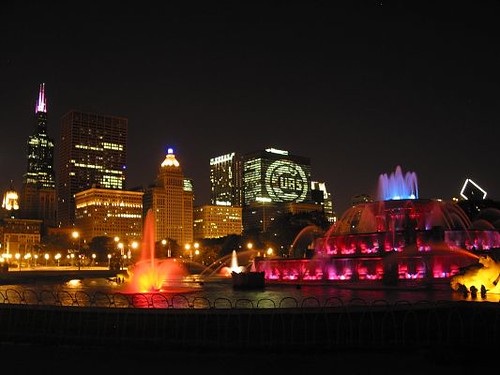
Any Cubs fan who moves away will probably tell you that the thing they miss most about Chicago are games at Wrigley Field, and that’s exactly what I was craving.
The funny thing is I don't even like baseball all that much. It can get kind of boring. And let's face it, if you're looking for superb athleticism you might want to try another sport. I was missing what happens once you walk into the stadium. The love of Cubs fans for their players is hard to explain, and I'm not sure most would want to understand it even if they could. There is one universal fact though, baseball fans love a good player no matter where they come from.
When I sat down at my first game of the season this year my heart swelled when I heard the crowd chanting Kosuke Fukodome's name (our star left-hander from Japan). Imagine arriving in a strange country with no friends and have 40,000 people rise to their feet to welcome you - every day. Kosuke may not have realized it, but in the hearts of Chicagoans he was one of us.
The same with Carlos Zambrano, who embodies the dreams of all the big farm boys pitching away in small towns across America. Then there's the story of Jim Edmonds...oh wait, he was actually born in America - well he used to be a Cardinal, so he’s actually the most foreign of all. And even though we needed some time to warm up to him, he's now loved like he's been a Chicagoan all along.
Most people who watch baseball understand that it's no longer a national pastime - it's an international pastime. It wouldn't be any fun without immigrants. Imagine turning on the game and not seeing Aramis Ramirez, Alfonso Soriano or Carlos Marmol step onto the field. What if all the immigrants disappeared from baseball? Would we even bother watching anymore? Now think about how we would feel if all the immigrants disappeared from our city and then our country.
We don't often like to admit it, but immigrants make this city and this country more vibrant. How would our lives change if we could transfer our loving embrace as baseball fans into other areas of our lives? What if we could take this love and bring it home or to our jobs or on our morning commute? What if we could look past an accent and block out the noise on Fox News and just see people for who they are? I think it would make this good city even better, maybe even as great as a summer day at Wrigley Field.
(Images gratefully borrowed from Wallyg's photostream (statue of liberty) and Chicago photogirl's photostream (Chicago skyline) at flicker.com/creativecommons)
Businesses Should Follow the Money Trail on Immigration

7-22-2008
(Image gratefully borrowed from Vinh Tran (on left) and WelcomingIdaho (at the bottom) at flicker.com/creativecommons)
Yesterday was hot and humid in Chicago. One of the things I like best about summer heat is that it gives me the perfect excuse to ingest one of Dunkin Doughnut’s Frozen Latte. Yesterday, while I was killing some time and sucking down my frozen latte, I decided to give in to another guilty pleasure and grab yesterday's New York Times.
As I was giving the front section a good look over, I noticed an editorial entitled Pushing Back on Immigration. In the editorial it is clear that business leaders are frustrated at their inability to secure a workforce and with the federal government’s unwillingness to create rational migration laws in the United States. The NYT editorial congratulated employers around the country who have banded together to defeat local and state-level anti-immigrant legislation.
What isn’t mentioned in the editorial is that the political action committees (PACs) of these same businesses have been some of the most enthusiastic financial supporters of the very same Congresspersons who have blocked meaningful immigrant legislation.
Consider Home Depot’s PAC; they gave $130,500 in campaign contributions to anti-immigrant politicians, more than 17% of its total donations. Ironically, these same elected politicians took Home Depots money with one hand, and with the other they introduced anti-immigrant legislation that directly attacks Home Depot – and the business community at-large - because of its supposed neutral stance on immigration.
Home Depot is not alone. Almost 2600 political action committees gave campaign contributions to anti-immigrant members during the 109th Congress (2005-2006), according to a comprehensive analysis of Federal Elections Commission records conducted by the Center for New Community.
As I sat there with my creamy frozen latte, I realized that even the milk industry was not immune from mistakenly financing individual members of Congress who, as a block, are responsible for creating the very labor shortage that the dairy industry currently faces.
All told, fifteen of the PACs closely tied to the dairy industry’s interests have contributed over $400,000 to anti-immigrant campaign coffers. In addition, when one adds the amount given by all agricultural related interests, the number sharply rises to millions of dollars. These anti-immigrant members of Congress have received campaign contributions from a surprisingly wide range of dairy industry sources, including Select Milk Producers PAC, United Egg Association EggPAC, and the Dairy Farmers of America Inc. DEPAC to name just a few. How did this happen?
While members of the business community tend to view congressional members as individuals, nearly a quarter of the House of Representatives have joined together to act as a bloc. Under the umbrella of the House Immigration Reform Caucus (HIRC), over 118 members of the U.S. House of Representatives have opposed virtually ever piece of key legislation aimed at relieving present labor shortages. In addition, HIRC members have increasingly placed the administrative burden of verifying the legal status of employees onto businesses themselves, forcing companies into acting like immigration enforcement officers.
The House Immigration Reform Caucus is led by Brian Bilbray, from California’s 50th Congressional District. Before his election to Congress, Bilbray was a lobbyist for the Federation for American Immigration Reform (FAIR), and today continues to serve as co-chair of it s National Board of Advisors. The Federation for American Immigration Reform has a long history of accepting funds and associating with political extremists, including some folks with ties to white supremacist organizations. As Bilbray took over the HIRC in January of 2007, the California congressman announced plans to “work closely” with groups, such as FAIR and the Center for Immigration Studies – a FAIR spin-off, to seek their input on legislation.
If business is really serious about encouraging realistic solutions, perhaps they might start by not financially supporting those who promote policies that can be fairly described as both inhumane and anti-business. Perhaps it’s time for them to put their money where their mouths are.
Do We Really Want Change?
By Sarah Viets
7-21-2008
Have you ever broken up with someone because they rarely stood on their own? Or because they stimulated you, but the tone of their words muted the sound of your voice - their words and thoughts towered over your every word.
I have. Then I promised myself I’d never date a replica of my past. I made a vow to meet someone who would challenge me and get me to see the world and myself through a different prism. I was so tired of making all the decisions, no matter how serious or trivial they were. Tired, tired tired…
But then life goes on and my previous experiences are remembered as a small and insignificant part of my past. I meet someone new and his/her personality appears to contrast a familiar face. But then I notice something. I’ve ended up exactly where I once was. Ugg! Who put a magic mirror above my bathroom sink?! Why do I continue to not see situations as they are; is my mirror permanently distorted?
Worse yet, I desire that familiar voice of the one who is responsible for my solace and despair.
I say I want change and want to try something new. I want to break away from the only experiences I’m most comfortable in. But when it comes down to it, my actions contrast my ideals. Instead, of choosing what I desire, I merely choose a different shade of a previous color.
I live in an age of change - an era that thrives to see and experience unfamiliar paths. The internet connects us to new ideas and people across the globe, allowing me to sit in my living room and download new movies and foreign rhythms and beats.
While the present moment rings of opportunity, the opportunities we choose are not optimistic.
People may claim they’re adaptable and “open-minded,” but the only people and ideas we believe are merely echoes our own. People really don’t seek anything different, just a larger exposition of what they already proclaim to know. And if somebody challenges a point of view, people don’t question the roots of a personal position. We respond in defense by clinging to our ideals while not knowing what the opposing side actually represents. We become loyal and rigid, keeping our feet locked in place. We don’t second-guess our original stance. Re-thinking previously stated opinions are defined as wavering weak assessments and not evolving conclusions.
At the same time, we present ingrained opinions; we don’t hesitate to say why someone is wrong. Individual interpretations based on personal experiences possibly explain unfamiliar patterns.
While I obsessively shuffle through a friend’s friend-list on facebook, search on-line for that Icelandic band I heard at a friend’s house, or play chess with cyber friends from who knows where, am I really taste-testing unaccustomed flavors?
With that said, do people prefer subconsciously pre-determined opinions? And if so, is the inability to feel grounded in undetermined conclusions an individual problem or a social phenomenon?
Looking at current events, debates about immigration reform usually present solutions that aren’t any different from the past. Proposed state-wind ballot initiatives and city council ordinances that try to address problems with immigration are masked as new and innovative approaches, but they’re not.
Kind of like old policies that either banned slavery, implemented “gradual” emancipation, or held tight to their slave auctions and enacted the Fugitive Slave Act. In fact, for more than 100 years, colonies and states couldn’t decide what to do. So they began to use their borders (like states and city ordinances) as a way to advance pro-slavery positions. Even more, there were over 20 different local and state wide policies that limited where black people could work, live, and who black folks could marry.
But states could never really decide what to do to. One minute they might pass some law to protect husbands, wives, daughters and sons running away from the south, and then the next minute they might protect segregation.
It was a HUGE mess. So much that the south declared itself independent from the north (the Southern Confederacy) so they could assert their strong support for buying and selling moms and dads like a piece of cattle.
Now, I know bringing up history is like bringing up a bad relationship that you’re trying to forget. But how can anyone learn from his or her mistakes unless they draw lessons from old mistakes?
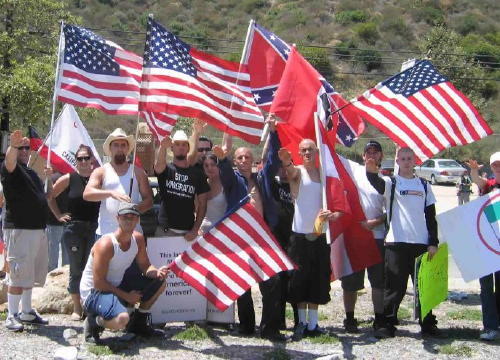
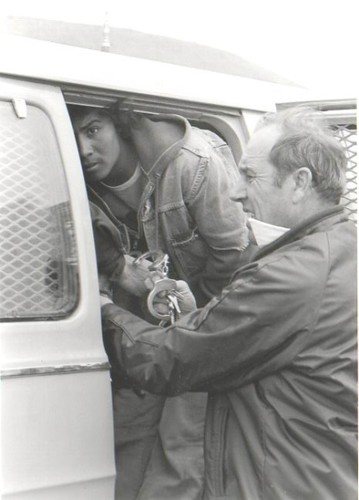
I know it’s easy to say slavery was bad, that our old relatives were off their rockers, but at one moment and time, they weren’t. It was socially acceptable to protect slavery and hunt for runaway slaves, kind of how the Minutemen (a modern anti-immigrant group on the border) hunts for immigrants on the border.
(and here's a picture)
We desperately need new ideas - we need change. But new non-traditional ideas should be examined with caution, unfamiliar views should at least be considered before firmly rejected. That’s what makes our country beautiful: the ability to challenge and adapt our American constitution.
Maybe its time to re-define what it means to be a Citizen. Maybe its time to re-think what it means to be American.
(picture gratefully used from www.dneiwert.blogspot.com)